EstampaMatch
A digital platform for FIFA World Cup 2026 sticker collectors to manage their collections, track duplicates, share what they need, and discover exchange opportunities.
Turning a manual collecting habit into structured data.
Sticker collecting is inherently social, but collectors often manage missing and duplicate stickers manually, making it difficult to discover who has exactly what they need.
ARG 07
BRA 14
MEX 03
GER 11
ARG 21 ×2
MEX 08 ×3
BRA 02 ×2
The real opportunity wasn't digitizing the checklist. It was making collection data connectable.
Utility first. Network value second.
EstampaMatch provides immediate utility through collection and duplicate tracking, while progressively building the structured data required for discovery and matching.
Collection
Track owned and missing stickers.
Duplicates
Manage stickers available for exchange.
Structured Collection Data
Public Profiles
Make collection data shareable.
Discovery + Matching
Find collectors with complementary collections.
Useful with one collector. More valuable with every connection.
Make 980 stickers feel manageable.
The challenge wasn't displaying hundreds of stickers. It was making the collection understandable at a glance, navigable at scale, and usable wherever collecting happens.
Know exactly where you stand.
Collection progress, missing stickers and duplicates are surfaced immediately, turning hundreds of individual items into a clear state.
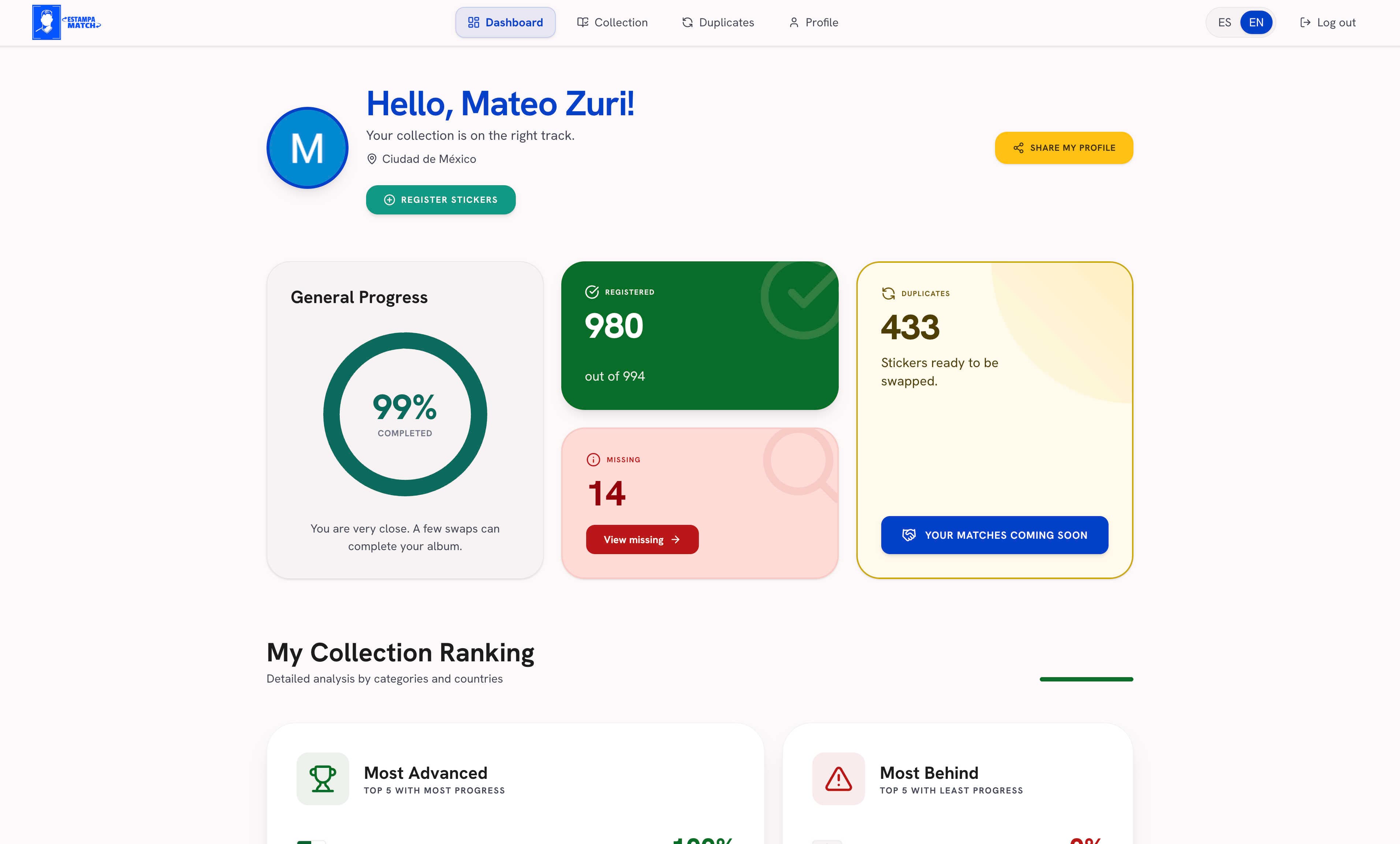
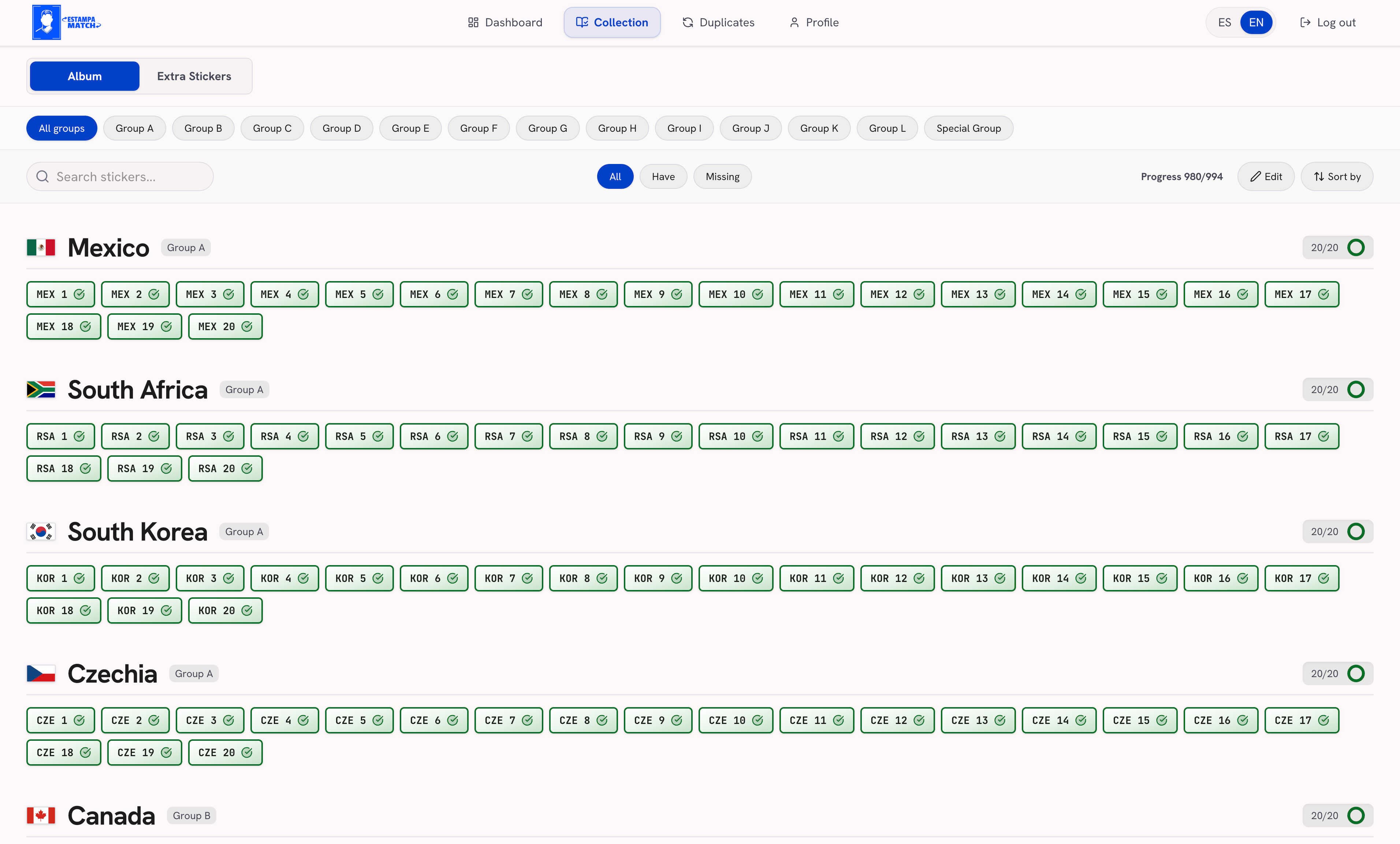
Hundreds of stickers. One navigable system.
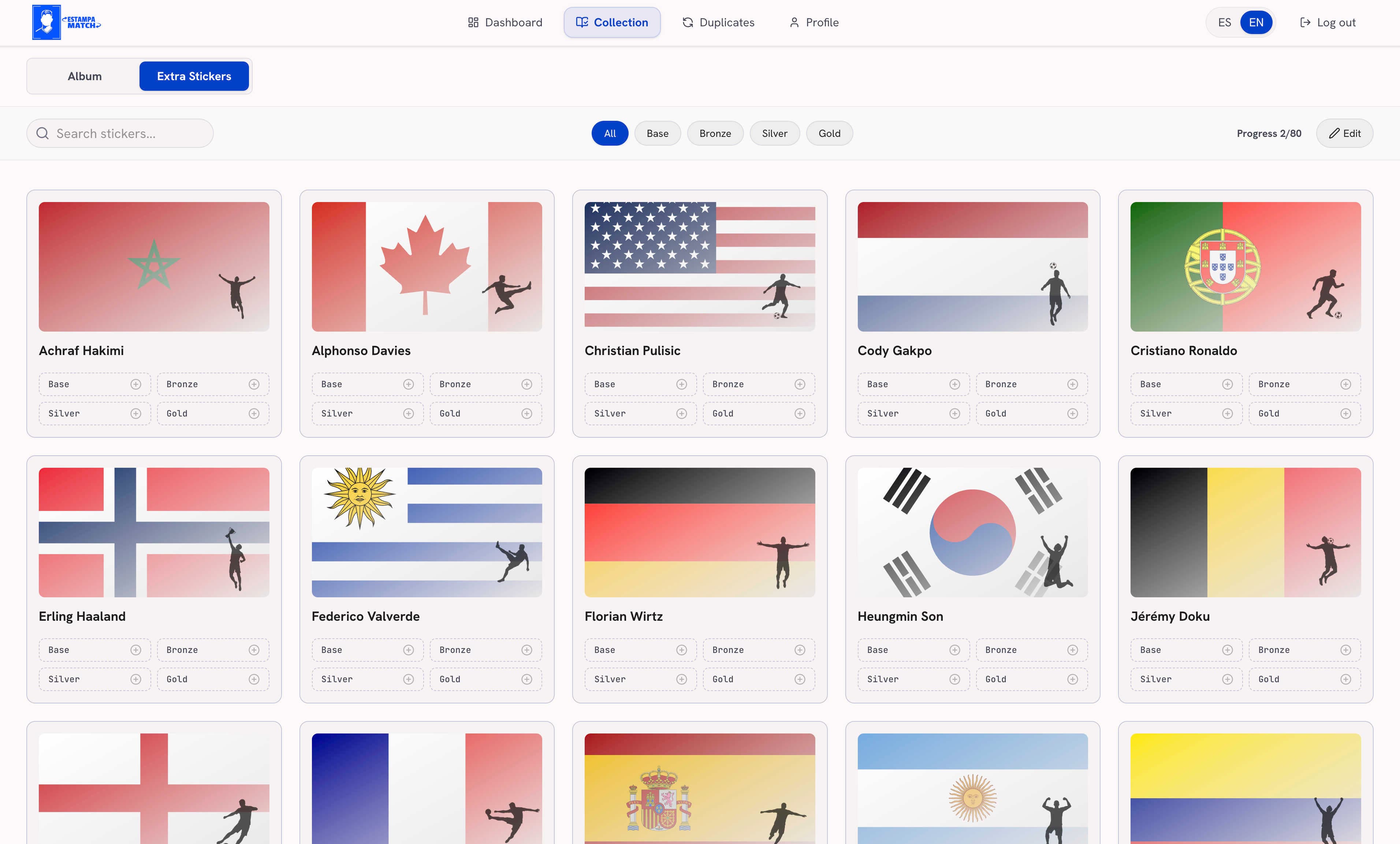
Groups, teams, search, filters and progress reduce a 980+ item collection into familiar, scannable layers.
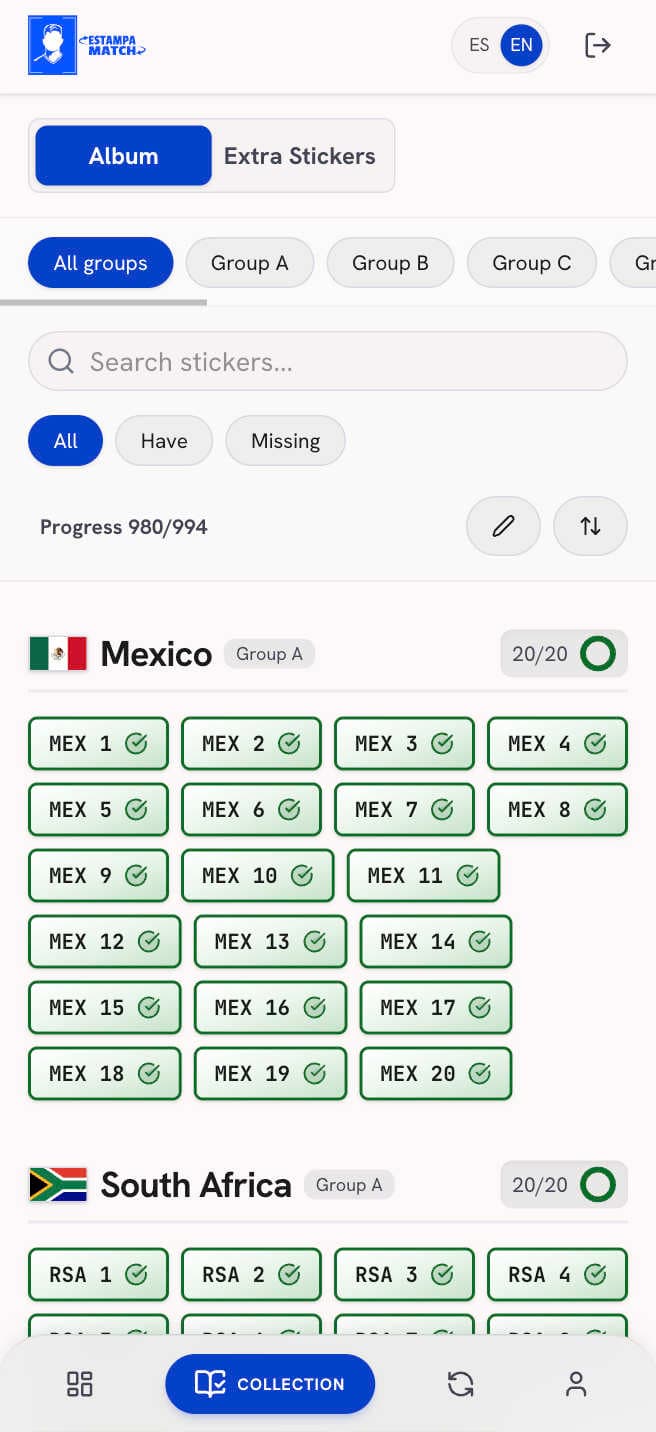
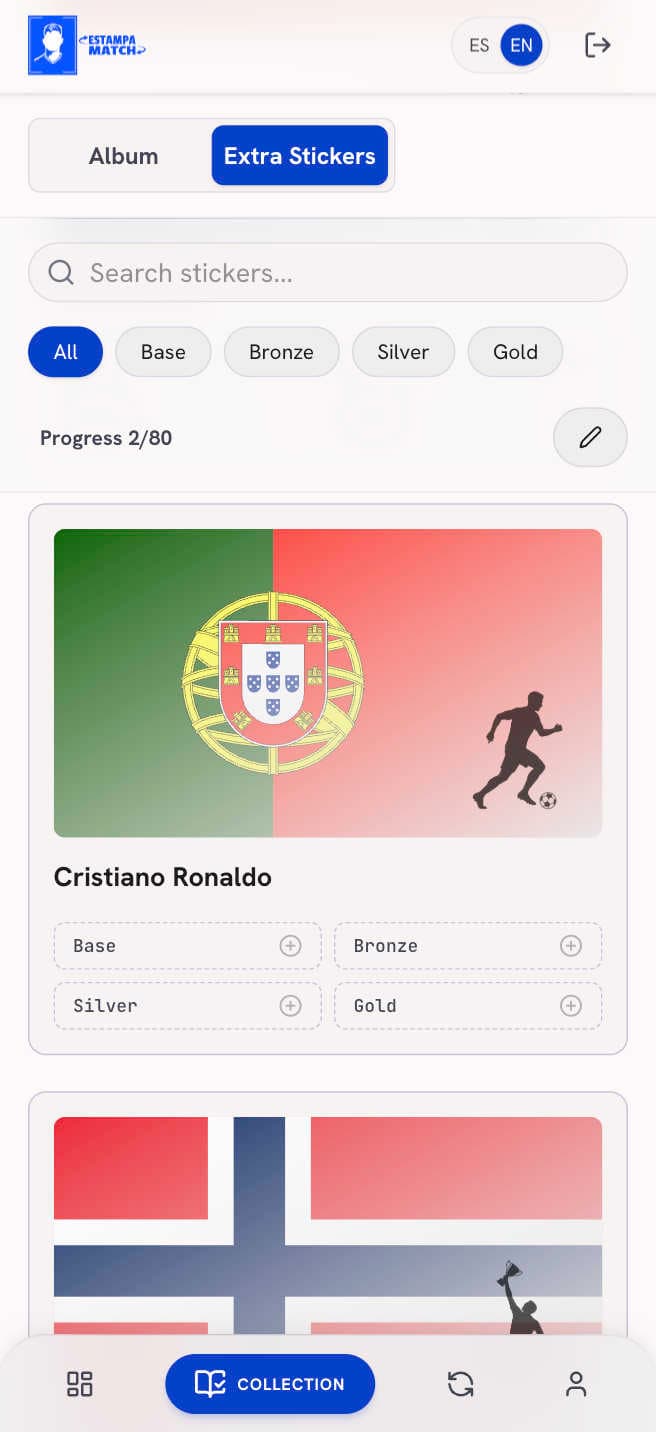
Complexity without cognitive overload.
Extra stickers introduce another dimension to the collection: players can exist across multiple variants without changing the core interaction model.
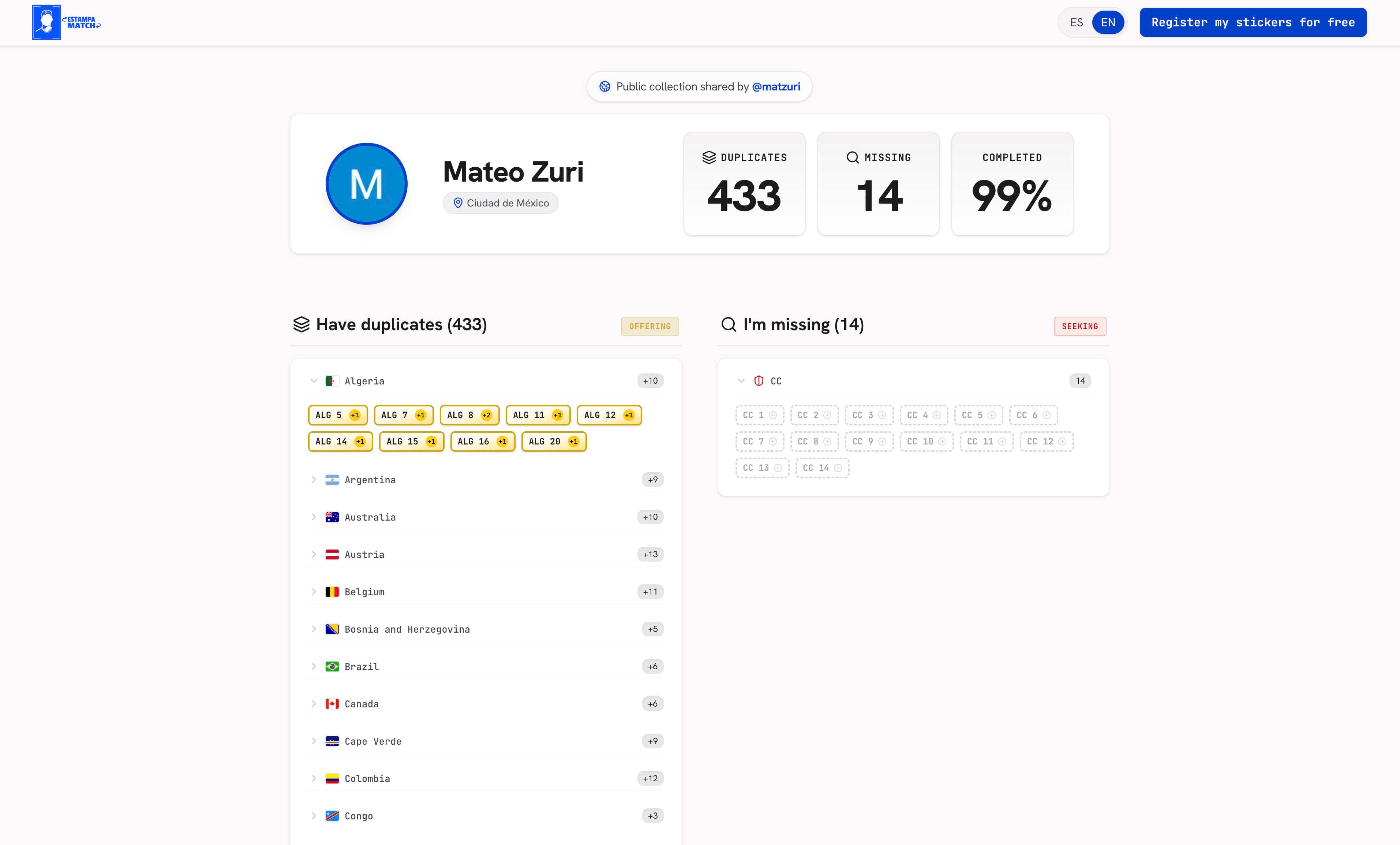
Private collection data becomes useful to others.
A public profile turns missing and duplicate stickers into a shareable representation of what a collector needs and what they can offer.
Designed for the scale of the collection.
Responsive to the moment of collecting.
Architecture shaped around the product.
The system was designed around the product's core behavior: turn individual collection activity into structured data that can power progress, sharing and eventually matching.
Collection state is the foundation.
Album metadata and sticker catalogs remain shared, while ownership and duplicates are modeled around each collector. The result is a consistent source of truth across every product surface.
Private state. Public representation.
Authentication, private collection management and public identity remain separate concerns, allowing collection data to be shared without coupling the public experience to the authenticated application.
Today's actions become tomorrow's network.
Every collection update already creates the inputs required to compare collectors. Matching therefore becomes an evolution of the existing data model rather than a separate product bolted on later.
Built for today's utility.
Structured for tomorrow's network.
Complexity where it creates value.
Model relationships instead of reconstructing them.
Albums, stickers, collectors and duplicates form a naturally relational domain. PostgreSQL keeps those relationships explicit and queryable while providing a clean foundation for future collector matching.
Don't build a backend before the product needs one.
Supabase provides authentication, PostgreSQL and managed data services without introducing a separate backend layer prematurely. The architecture stays simple today while preserving a clear path to dedicated services when product scale or business logic justifies them.
COMPLEXITY
TRANSITION
One collection state. Multiple product surfaces.
Dashboard progress, missing stickers, duplicates and public profiles are derived from the same underlying collection state rather than maintained as independent representations. Fewer sources of truth mean fewer synchronization problems as the product evolves.
Measure behavior before optimizing assumptions.
Meaningful interactions are captured as product events, including collection updates, duplicate management, searches, filters, profile views and CTA interactions. This creates evidence for what users actually do before deciding what to build or optimize next.
Build what creates value.
Earn the complexity that comes next.
Engineering decisions are business decisions.
EstampaMatch follows a progressive value model. Product and technical investment increase only as user behavior creates evidence for the next stage, moving from individual utility to network value and eventually to monetization.
EstampaMatch starts by solving a problem for one collector: knowing what they have, what they are missing and what they can trade.
Collection tracking creates state. Duplicates create exchange supply. Public profiles create discovery. Together they create the conditions for a network.
Matching, payments and additional infrastructure should follow demonstrated recurring behavior and exchange density, not precede it.
Create value first.
Built end-to-end.
EstampaMatch went from a real collector problem to a production product, defined, designed, engineered, instrumented and shipped as one connected system.
Owning the complete path created a direct feedback loop between product decisions, engineering decisions and real user behavior, allowing the system to evolve around evidence rather than assumptions.
Usage signals
Iteration